


Violence-Inducing Behaviour Prevention in Social-Cyber Space of Local Communities
Researcher Project for Technological Convergence Related to Enabling Technologies

The project creates the foundation of a transformative new technology for combating radicalization and hate speech in online social spaces
Scan to see SOCYTI in action!
About SOCYTI
Online hate speech, radicalization, and polarization have become major challenges for democratic societies. These harmful online dynamics not only threaten people's safety, well-being, and participation in public life, but can also undermine trust, complicate crisis communication, and reduce the effectiveness of public authorities and emergency response during disasters.
The SOCYTI project addresses these challenges by exploring how harmful online behaviour affects local communities and by developing innovative methods to detect emerging risks in digital social environments.
Bringing together expertise from computational social science, artificial intelligence, and social sciences, SOCYTI has developed advanced approaches for real-time monitoring and analysis of online discourse. By combining AI, big data technologies, and social media analysis, the project provides new tools and knowledge to help identify patterns of hate speech, radicalization, and polarization before they escalate into wider societal risks.
Throughout the project, particular attention has been given to the ethical, legal, and societal implications of analysing online data. This ensures that technological innovation is accompanied by responsible research practices that respect fundamental rights and democratic values.
SOCYTI leaves behind valuable scientific insights, methodological advances, and practical tools that can support researchers, policymakers, public authorities, and local communities in strengthening societal resilience in an increasingly digital world.
Objectives
Assess harmful online behaviours and their impact on local communities and societal resilience.
Develop advanced, real-time methods to detect online risks and support timely, evidence-based responses.
Methodology
The SOCYTI project follows an interdisciplinary research approach that combines social science, data analysis, and artificial intelligence to understand and address harmful online behaviours. The project is structured around three interconnected phases: Studies, Strategies, and Software. These phases are implemented through dedicated Work Packages that collectively support the achievement of SOCYTI’s objectives.
The Studies phase focuses on understanding the nature, drivers, and consequences of online hate speech, radicalization, and polarization. Using approaches from computational social science, the project analyses online social environments while considering ethical, legal, and societal dimensions of data use.
The Strategies phase translates research findings into approaches for identifying, assessing, and mitigating risks to community resilience. A key innovation of SOCYTI is the development of a hybrid multi-task learning framework for detecting multilingual violence-inducing behaviours online. This framework combines advanced artificial intelligence methods, including knowledge graphs, text classification, sentiment analysis, and deep neural networks, to improve the detection and understanding of complex online interactions across languages and contexts.
The Software phase focuses on transforming research outcomes into practical technological solutions. By developing advanced tools for monitoring and analysing online environments, SOCYTI aims to support timely identification of emerging risks and strengthen the capacity of communities and public actors to respond to harmful digital dynamics.
Through this integrated methodology, SOCYTI advances transformative innovation by bringing together cutting-edge AI technologies and social science perspectives. The project contributes to the development of responsible, human-centred technologies that can enhance community resilience while addressing the ethical and societal challenges associated with digital communication.


The project flyers
Project Manager: Rajendra AkerkarProject Owner: Western Norway Research InstituteDuration: May 2022– September 2026 




SOCYTI researchers with Prof. Kathleen Carley (CMU) at SAIDD 2023 symposium (Photo credit: Torborg Lgland)

SOCYTI workshop at Kristiansand in October 2022 (Photo: R. Akerkar)

Pål Tore Haga (Vest politidistrikt) presenting at SOCYTI project workshop at Kritiansand.

Carol Azungi Dralega and Torborg Igland of NLA University at SAIDD 2023 in Sogndal. (Photo: Torborg Igland)

Yasas Senarath, George Mason University, presented a guest seminar at Vestlandsforsking in October 2022.

SOCYTI team at Kristiansand workshop
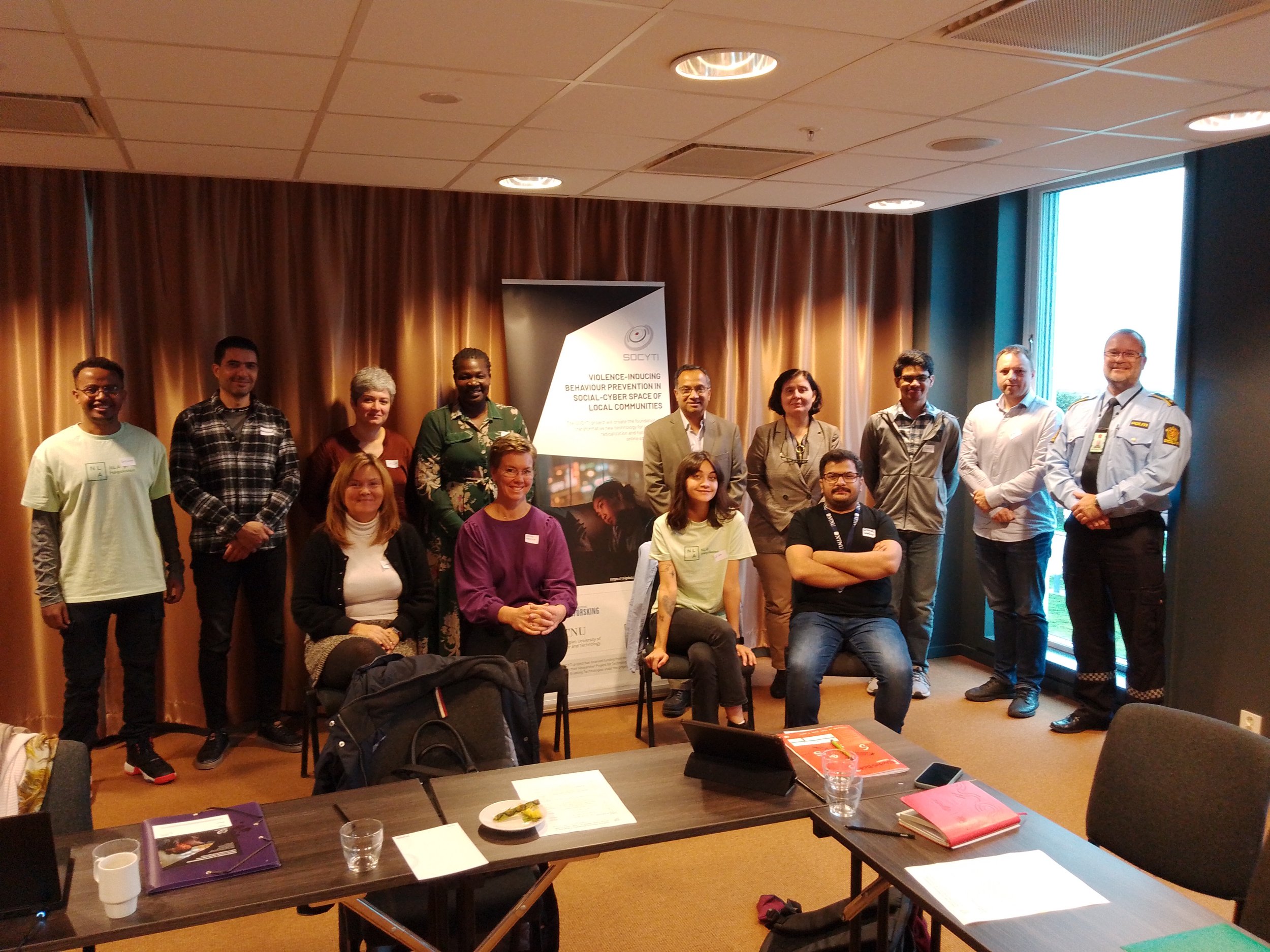
Members of the SOCYTI project at workshop at NLA University in October 2022.
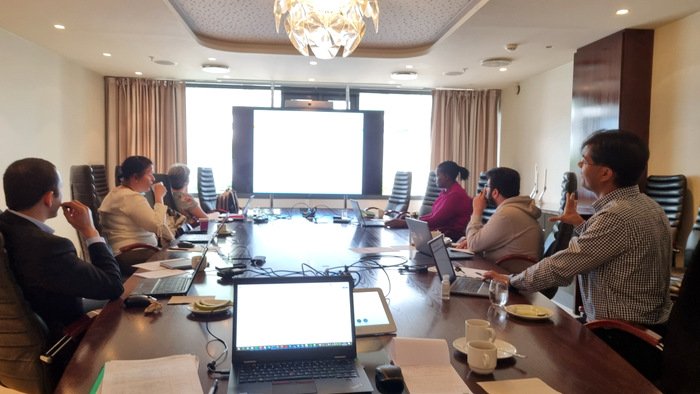
The project team at the Kick-Off meeting in Sogndal.

Social event of the SOCYTI at Urnes.

Social dinner during the SOCYTI kick-off meeting in June 2022.

Professor Sule Yildirim Yayilgan of NTNU Gjøvik presenting at the project board meeting in October 2022.

Presentation by the Reference Group member at the SOCYTI workshop at Kritiansand.

SOCYTI 2nd Stakeholder Workshop in Oslo on 13 March 2024.

SOCYTI 2nd Stakeholder Workshop in Oslo on 13 March 2024.

SOCYTI 2nd Stakeholder Workshop in Oslo on 13 March 2024.

SOCYTI 2nd Stakeholder Workshop in Oslo on 13 March 2024.

Dante Della Vella gave a presentation on "Reflections on incorporating RRI goals into online violence prevention research" at the AFINO International Conference: Transformative Research and Innovation, Oslo. (30 August 2024)
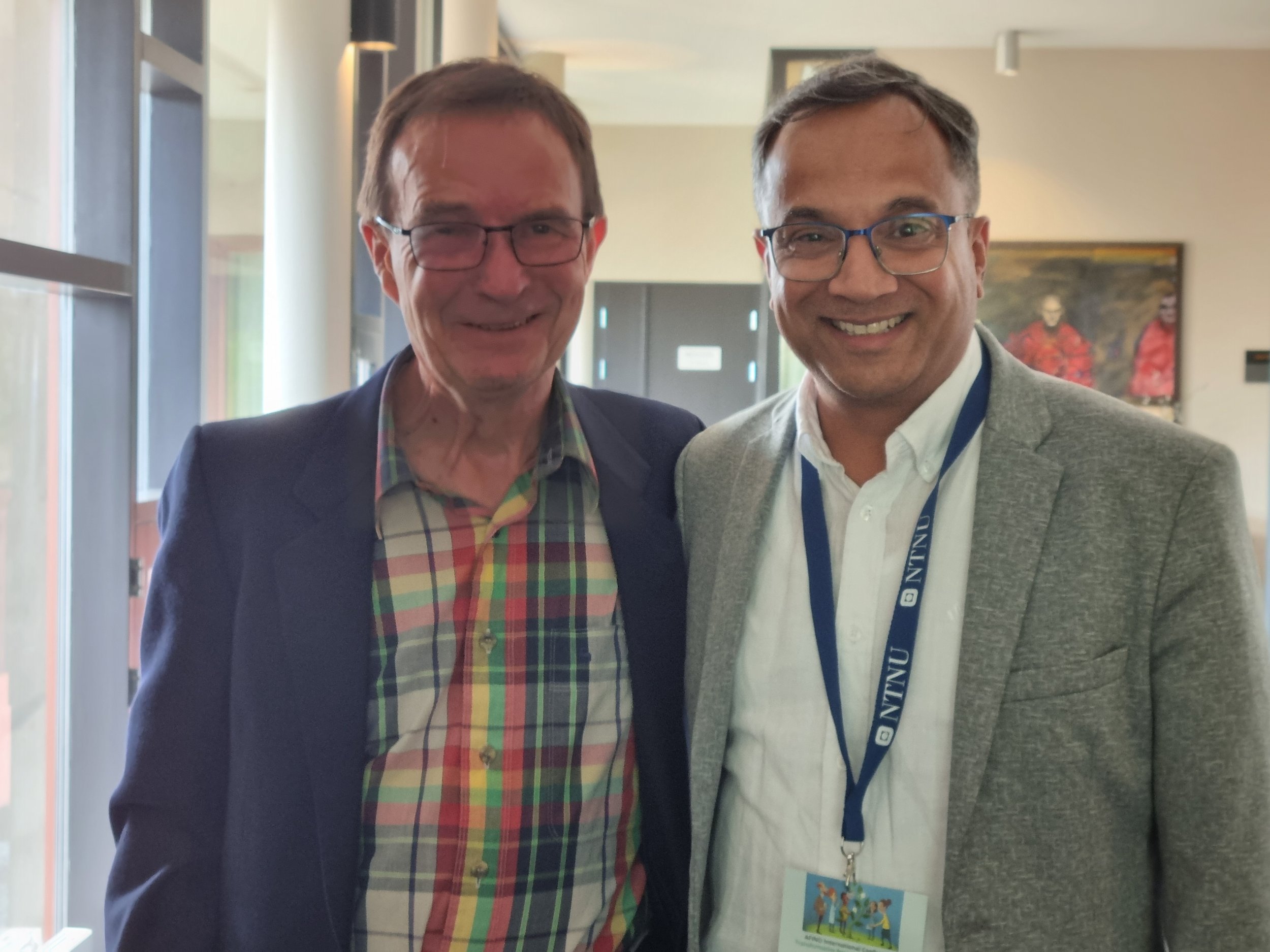
At the AFINO International Conference: SOCYTI Project Manager Professor Akerkar with Helge Rynning of the Research Council of Norway (30 August 2024)

SOCYTI project took part at the Forskningsdagene (Open Science Exhibition) in Kristiansand on 14th September 2024. Our project partner NLA University College represented by Carol Azungi Dralega and Torborg Igland were engaging members of the public - young and old and from all walks of life, through interactive activities, prizes and discussions. The aim of their participation in this event was not only to bridge the gap between science (academic research) and society by raising awareness but to also promote bottom-up knowledge exchange on such a critical societal challenge. The NLA team was joined by Turid Terje Sunnarvik (IT), Turid Vevatne (Information) and two BA students interested in the topic.

SOCYTI project took part at the Forskningsdagene (Open Science Exhibition) in Kristiansand on 14th September 2024. Our project partner NLA University College represented by Carol Azungi Dralega and Torborg Igland were engaging members of the public - young and old and from all walks of life, through interactive activities, prizes and discussions. The aim of their participation in this event was not only to bridge the gap between science (academic research) and society by raising awareness but to also promote bottom-up knowledge exchange on such a critical societal challenge.

SOCYTI project took part at the Forskningsdagene (Open Science Exhibition) in Kristiansand on 14th September 2024.

SOCYTI project took part at the Forskningsdagene (Open Science Exhibition) in Kristiansand on 14th September 2024. Our project partner NLA University College represented by Carol Azungi Dralega and Torborg Igland were engaging members of the public - young and old and from all walks of life, through interactive activities, prizes and discussions.

SOCYTI project took part at the Forskningsdagene (Open Science Exhibition) in Kristiansand on 14th September 2024.

SOCYTI project took part at the Forskningsdagene (Open Science Exhibition) in Kristiansand on 14th September 2024.
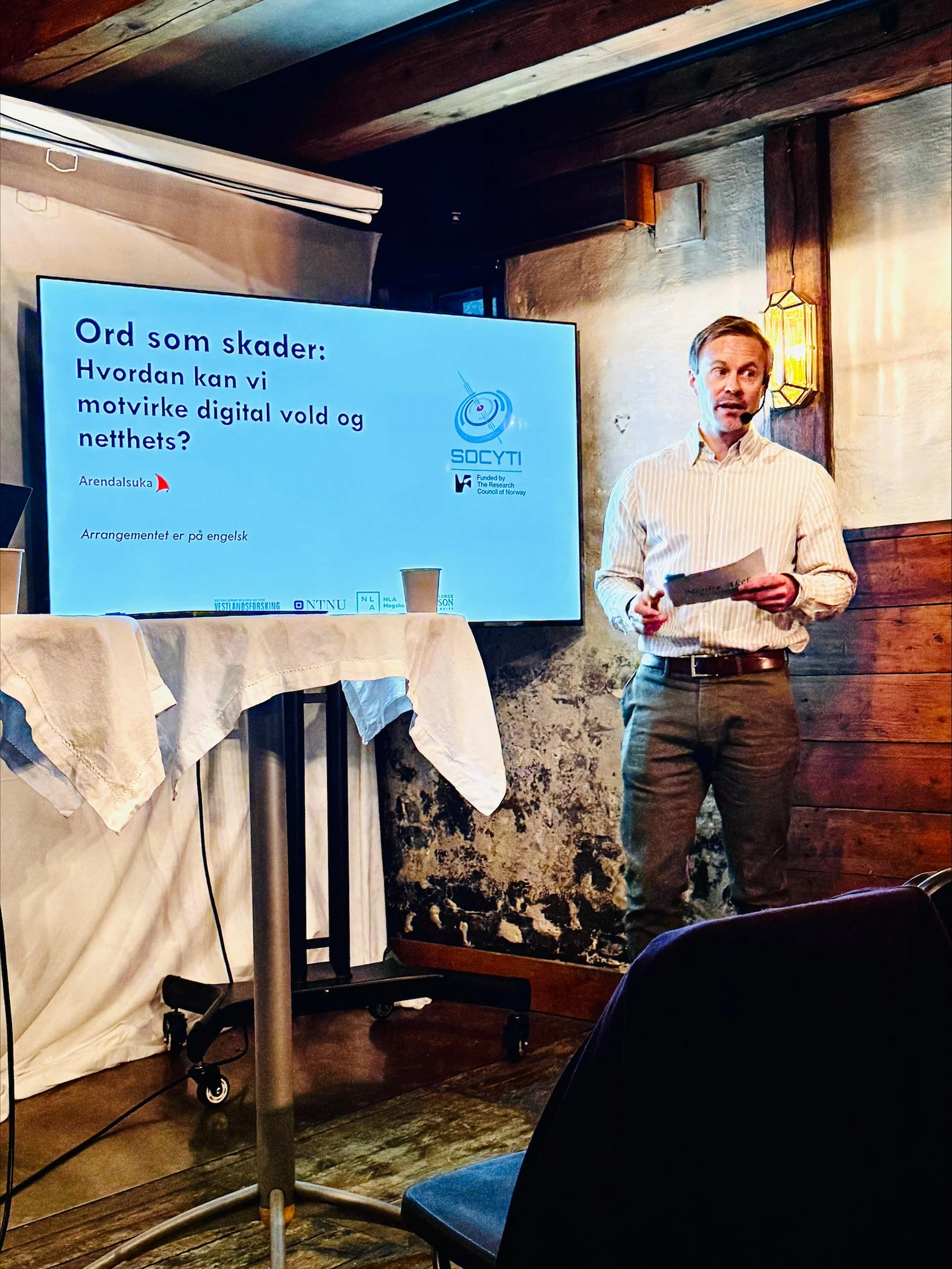
SOCYTI at Arendalsuka 2026
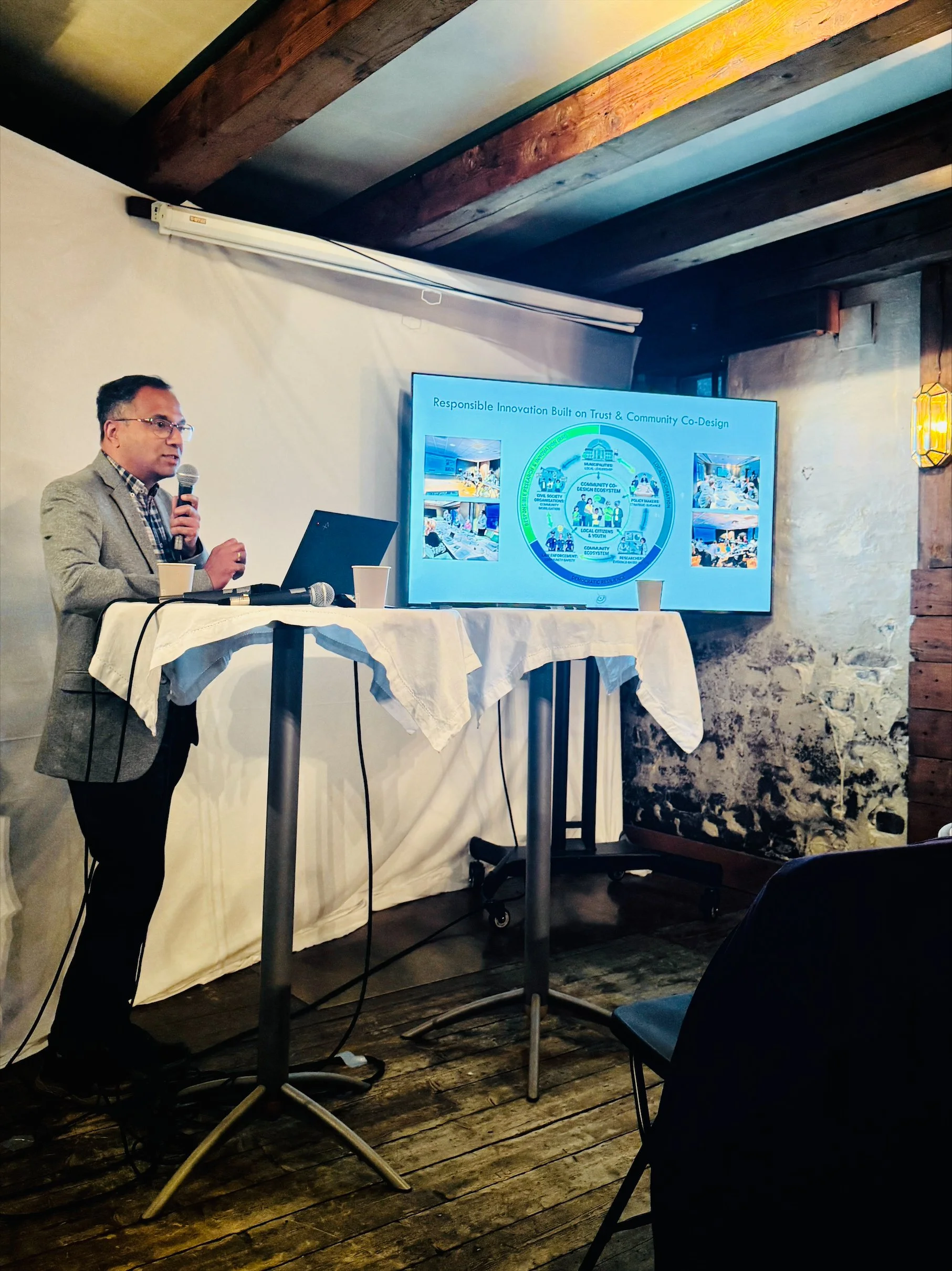
SOCYTI at Arendalsuka 2026
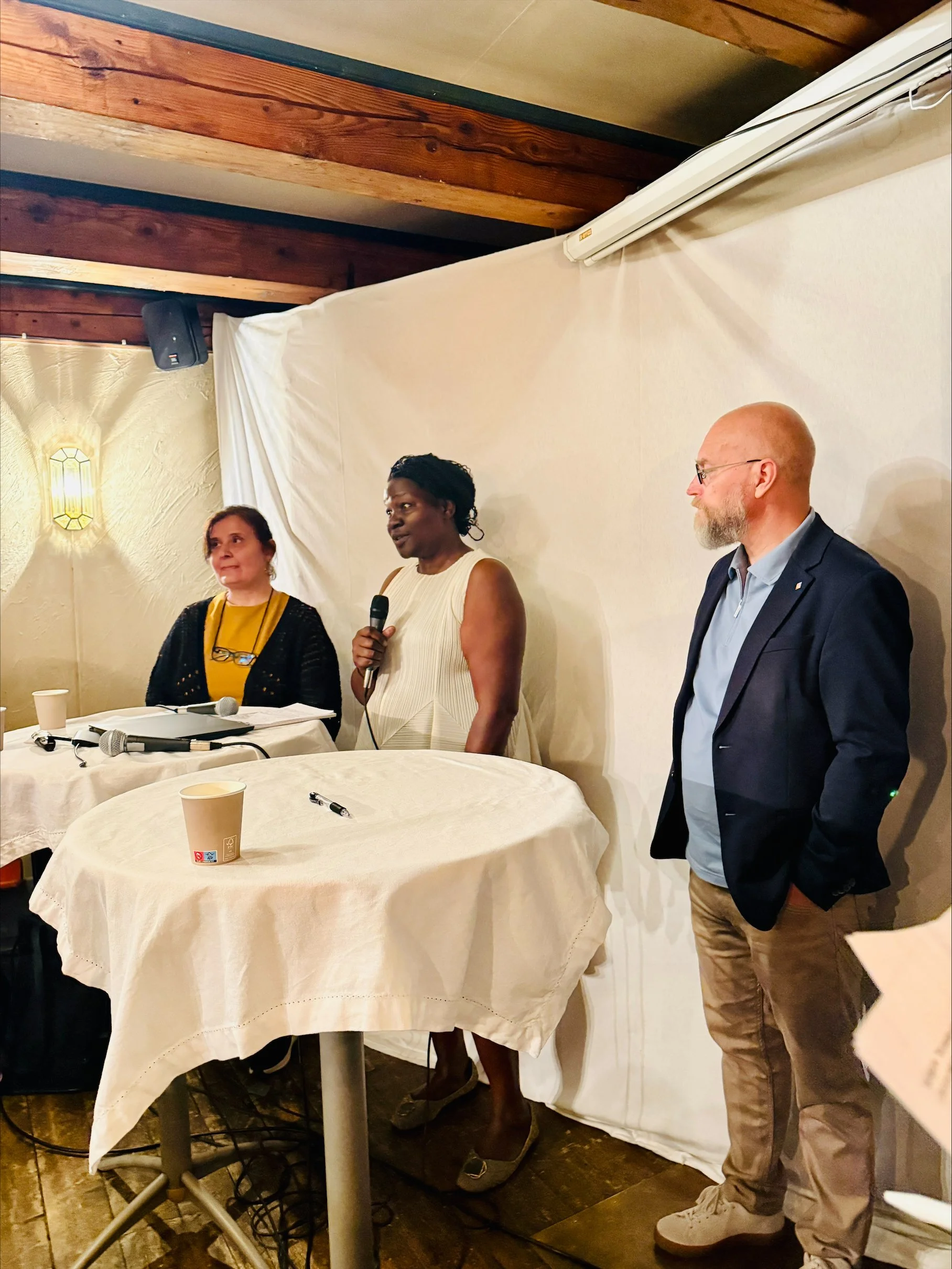
SOCYTI at Arendalsuka 2026
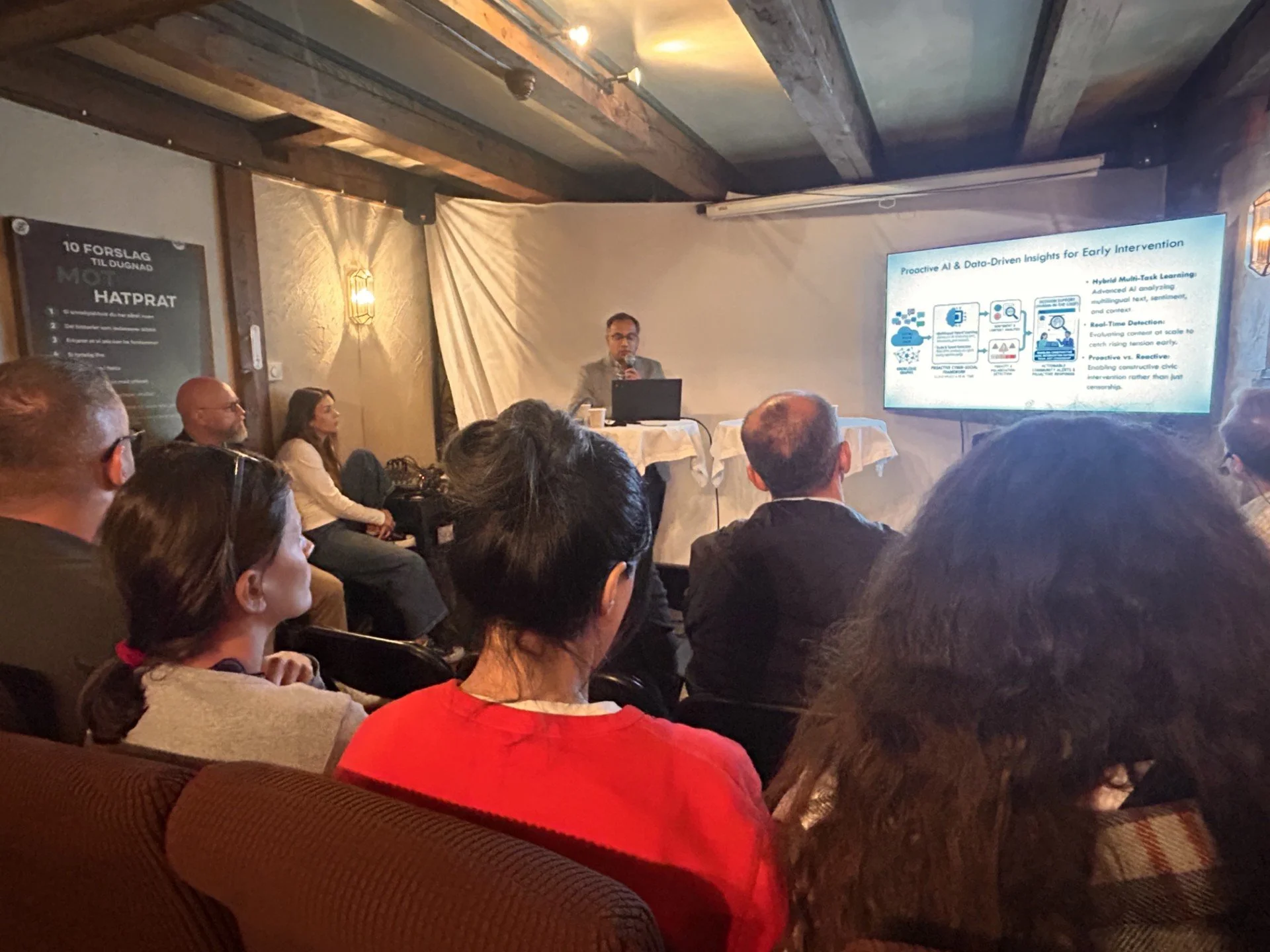
SOCYTI at Arendalsuka 2026
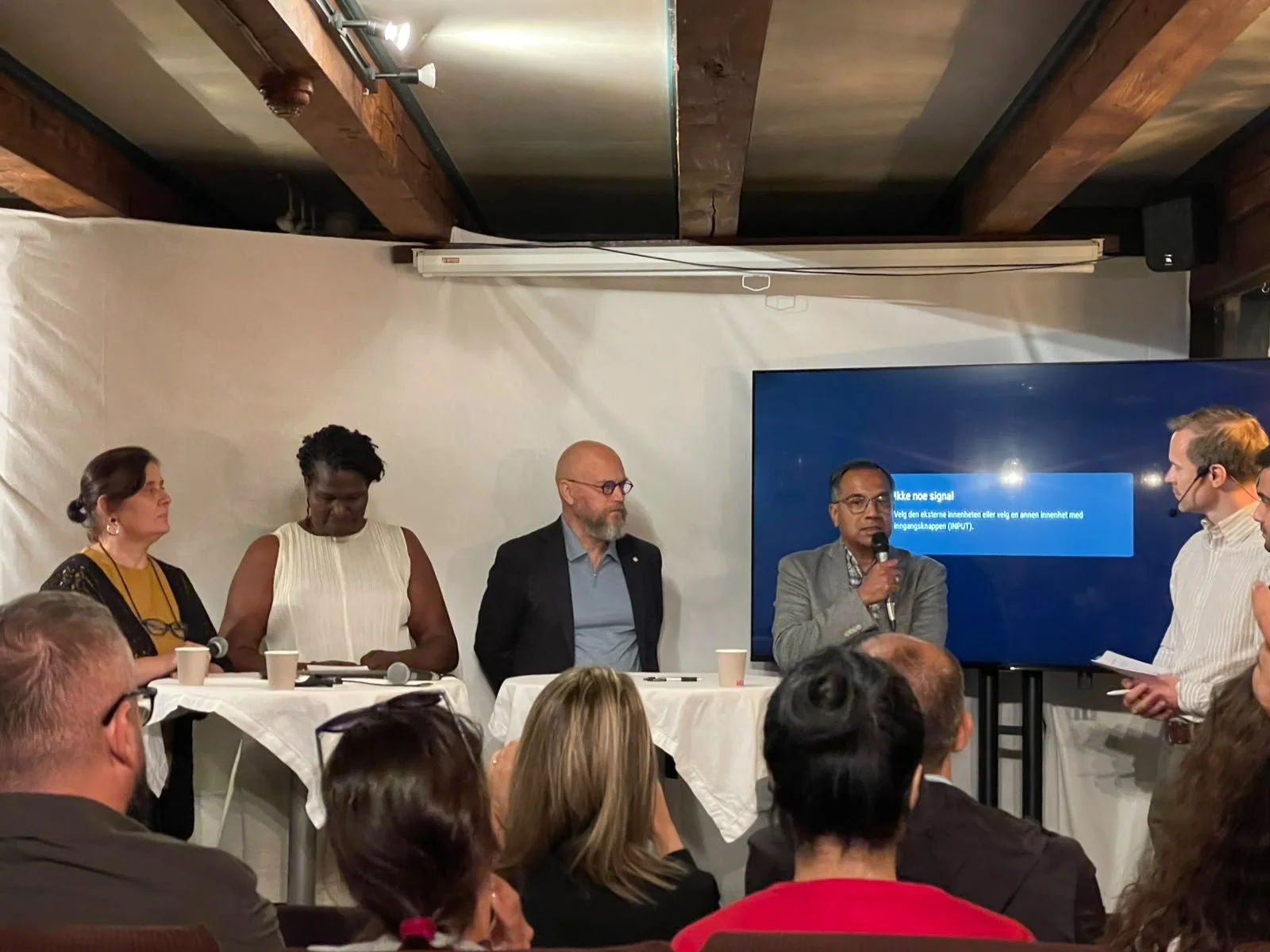
SOCYTI at Arendalsuka 2026
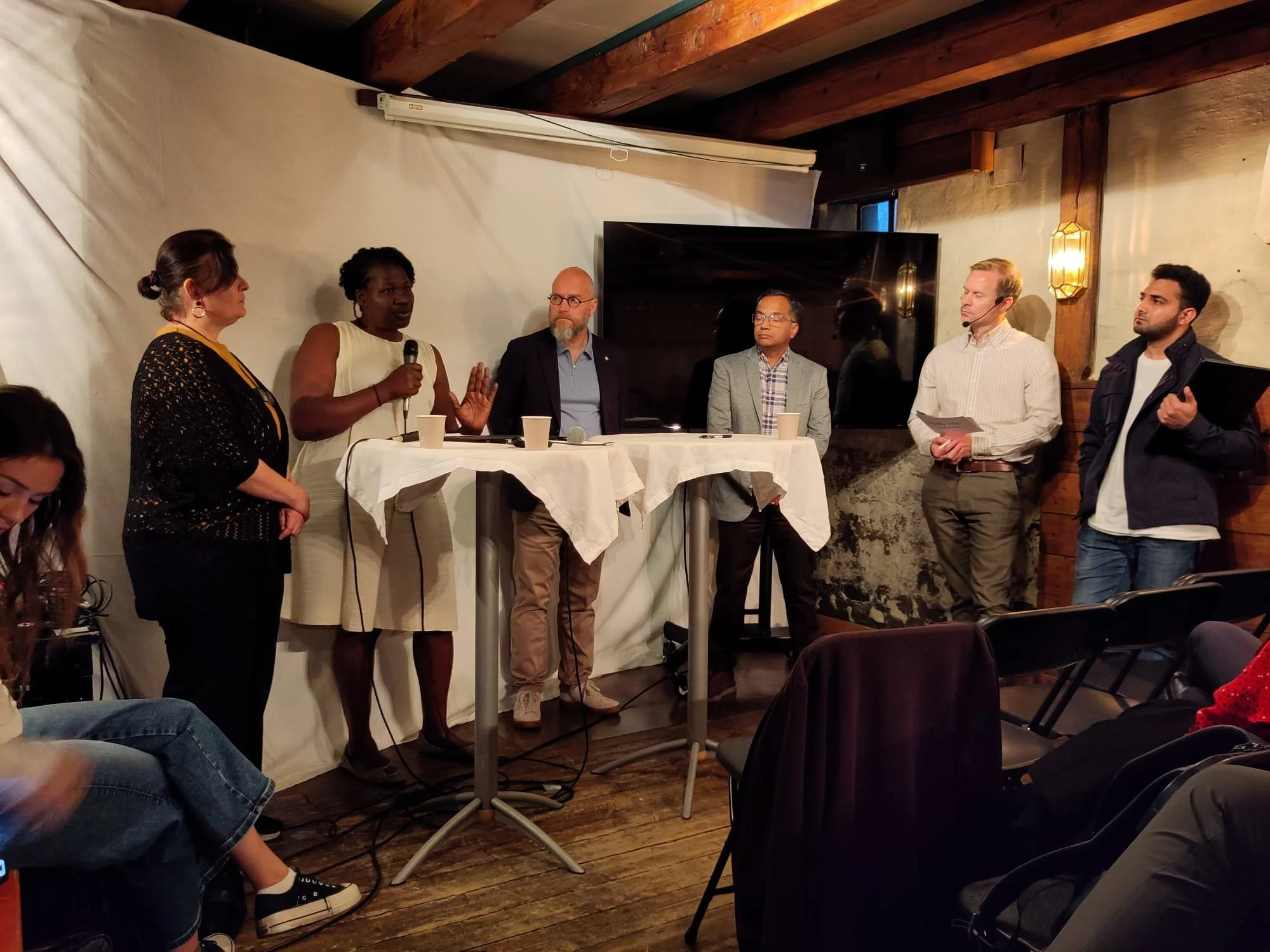
SOCYTI at Arendalsuka 2026
Dissemination (For SOCYTI publications in NVA)
Publications
Hashmi, E., Shaikh, S., Yildirim-Yayilgan, S., Riaz, W., Abomhara, M., & Akerkar, R. (2026). Tertiary Cyberbullying Detection Using Machine Learning and Captum-Based Explainability. IEEE Xplore.
Hashmi, E., Yayilgan, S.Y., Abomhara, M., Akerkar, R. (2026). CoR-Hate: Counterfactual Retrieval and Fairness-Regularized Hate-Speech Detection. Complex & Intelligent Systems. https://doi.org/10.1007/s40747-026-02528-5.
Dralega, C.A. Humor, Hate, and Human Rights: Media Discourses in the Ali–Antonsen Case. Accepted for publication in Howard Journal of Communications (Routledge Taylor & Francis).
Dralega, C.A., Building Community Resilience against Online Hate Speech in Norway: A Study of Stakeholder Practices and Gaps. Accepted/in production in the Emerald volume Cyber-Ethics, Techno-Ethics and Digital Media.
Senarath, Y., & Purohit, H. (2025, November). Knowledge-guided Continual Learning for Behavioral Analytics Systems. In 2025 IEEE 7th International Conference on Cognitive Machine Intelligence (CogMI) (pp. 1-11). IEEE.
Dante Della Vella, Yasas Senarath, Ehtesham Hashmi, Mohamed Abomhara, Sarang Shaikh, Torborg Igland, Carol Azungi Dralega, Sule Yildirim Yayilgan, Hemant Purohit & Rajendra Akerkar.Eliciting Socio-Technical Research Needs on Countering Violence-Inducing and Hateful Speech in Cyberspace. Digit. Soc.4, 62 (2025). https://doi.org/10.1007/s44206-025-00212-8.
Hashmi, E., Mazhar, M.T., Yayilgan, S.Y. , Akerkar, R., Afzal, M. Exposing shortcut sensitivity in English–Norwegian hate speech detection via neutral stability analysis. Soc. Netw. Anal. Min. (2026). https://doi.org/10.1007/s13278-026-01636-x
Hashmi, E., Yildirim Yayilgan, S., Abomhara, M., Akerkar, R. (2025). Transparent Hate Speech Detection in Norwegian Using Explainable AI. In: Kahraman, C., et al. Intelligent and Fuzzy Systems. INFUS 2025. Lecture Notes in Networks and Systems, vol 1529. Springer, Cham. https://doi.org/10.1007/978-3-031-97992-7_68.
S. Shaikh, E. Hashmi, S. Y. Yayilgan, M. Abomhara and R. Akerkar, "Improving Text Classification by Fusing Linguistic and Semantic Features," 2025 6th International Conference on Advancements in Computational Sciences (ICACS), Lahore, Pakistan, 2025, pp. 1-8, doi: 10.1109/ICACS64902.2025.10937797. (Best paper award)
Ehtesham Hashmi, Sule Yildirim Yayilgan, Muhammad Mudassar Yamin, Mohamed Abomhara, Mohib Ullah. Self-supervised hate speech detection in Norwegian texts with lexical and semantic augmentations, Expert Systems with Applications, Volume 264, 2025, 125843, ISSN 0957-4174, https://doi.org/10.1016/j.eswa.2024.125843.
Hashmi, E., Shaikh, S., Yayilgan, S.Y., Abomhara, M., Akerkar, R. & Afzal, M. Multi-domain text classification via linguistic and semantic feature integration. Soc. Netw. Anal. Min.15, 113 (2025). https://doi.org/10.1007/s13278-025-01551-7.
E. Hashmi, S. Yildirim Yayilgan, I. A. Hameed, M. Mudassar Yamin, M. Ullah and M. Abomhara, "Enhancing Multilingual Hate Speech Detection: From Language-Specific Insights to Cross-Linguistic Integration," in IEEE Access, vol. 12, pp. 121507-121537, 2024, doi: 10.1109/ACCESS.2024.3452987.
Dralega, C.A., Igland, T., Seddighi, G. (2024). Challenges in Regulating Online Hate-Speech Within the Norwegian Context. In: Akerkar, R. (eds) AI, Data, and Digitalization. SAIDD 2023. Communications in Computer and Information Science, vol 1810. Springer, Cham. https://doi.org/10.1007/978-3-031-53770-7_12.
Senarath, Y., Purohit, H., Akerkar, R. (2024). Violence-Inducing Behavior Prevention in Social-Cyber Space. In: Akerkar, R. (eds) AI, Data, and Digitalization. SAIDD 2023. Communications in Computer and Information Science, vol 1810. Springer, Cham. https://doi.org/10.1007/978-3-031-53770-7_10.
Hashmi, Ehtesham; Yildirim-Yayilgan, Sule; Shaikh, Sarang. (2024) Augmenting sentiment prediction capabilities for code-mixed tweets with multilingual transformers.Social Network Analysis and Mining.
Ali, Hashir; Hashmi, Ehtesham; Yildirim-Yayilgan, Sule; Shaikh, Sarang. (2024) Analyzing Amazon Products Sentiment: A Comparative Study of Machine and Deep Learning, and Transformer-Based Techniques.Electronics (Basel).
Hashmi, Ehtesham; Yildirim-Yayilgan, Sule. (2024) A robust hybrid approach with product context-aware learning and explainable AI for sentiment analysis in Amazon user reviews.Electronic Commerce Research.
Hashmi, E., Yayilgan, S.Y. Multi-class hate speech detection in the Norwegian language using FAST-RNN and multilingual fine-tuned transformers. Complex Intell. Syst. (2024). https://doi.org/10.1007/s40747-024-01392-5.
E. Hashmi, S. Y. Yayilgan, M. M. Yamin, S. Ali and M. Abomhara, "Advancing Fake News Detection: Hybrid Deep Learning with FastText and Explainable AI," in IEEE Access, doi: 10.1109/ACCESS.2024.3381038.
D. Della Vella, H. Nguyen, and R. Akerkar, “The Utility of Community Resilience Models for the Prevention of Online Violence”, ISCRAM, vol. 21, May 2024, Accessed: May 22, 2024.
Presentations
Dralega Carol Azungi. Participation in a global virtual round table entitled “Voices with Impact: Women Leading a Culture of Responsible Communication” on the occasion of International Women’s Day, hosted by the International Committee on Countering Extremist and Hate Speech (ICCEHS) . Watch the full video🎥 and relive the highlights of this remarkable event.
Y. Senarath and H. Purohit, "Lifelong Learning Framework for Multilingual Hate Speech Detection in Social Media Streams" in Proc. 17th Int. Conf. Social Computing, Behavioral-Cultural Modeling, & Prediction and Behavior Representation in Modeling and Simulation (Working Papers), Sep. 2024.
Dralega Carol Azungi and Igland Torborg. Building resilience against online hate-speech – perspectives and synergies from stakeholders within Norwegian contexts. Session Digital Culture at Norsk Mediekonferanse 2024, Ålesund, 17-18 October. (Accepted 2024)
Dralega Carol Azungi and Igland Torborg (2024) Sammen mot Hatprat (Together against Hate Speech). 14th September, 2024, Kristiansand. National Open Science Day (Forskningsdagene) 2024 Theme: Health. 18 – 29 September 2024. (OPEN SCIENCE DAY - FORSKNINGSDAGENE)
Dante Della Vella, Carol Azungi Dralega, Torborg Igland and Rajendra Akerkar. Reflections on Incorporating RRI Goals into Online Violence Prevention Research, at the AFINO International Conference, Oslo, 30th August 2024.
Dralega Carol Azungi and Torborg Igland (2024) A victims’ lens into the dark side of online hate speech, at UNESCO’s World Press Freedom Day 2024 Academic Conference, Chile. Session: Safeguarding Press Freedom amindst Journalist unsafety. 1-4th May, 2024. University of Chile.
Igland Torborg and Dralega Carol Azungi (2023) The Battle over rights, balance and entitled racism – a discourse analysis of media coverage of Sumaya Jirde Ali-Atle Antonsen Case, session on News Content. At NORDMEDIA2023 - Technological Takeover? Social and Cultural implication - Promises and Pitfall, August, 16 – 18 Bergen.
Torborg Igland, Carol Azungi Dralega and Gilda Seddighi. Unpacking the tensions in the Legal Regulation of Online Hate-Speech within the Norwegian Context. In Proceedings ofSymposium on AI, Data and Digitalization (SAIDD 2023), ISBN: 978-82-428-0457-0, 2023.
Yasas Senarath, Hemant Purohit and Rajendra Akerkar. Violence-inducing Behaviour Prevention in Social-Cyber Space. In Proceedings of Symposium on AI, Data and Digitalization SAIDD 2023, Sogndal, Norway. ISBN 978-82-428-0457-0, May 2023.
Hemant Purohit. Leveraging Open Knowledge Networks to Enhance Data Analytics for Social Good.Open Knowledge Networks (OKN) Workshop, ACM SIGKDD Conference, Washington DC, 2022.
Gilda Seddighi. Temasamling om netthets og hatefulle ytringer. Empo - flerkulturelt ressurssenter, Bergen, 2022.
In Media
Vi har jo loven mot netthat, eller har vi? Carol Azungi Dralega and Torborg Igland, Dagsavisen, 14.10.2026.
Pillay viste at ord kan drepe. Hva lærer vi av det? Carol Azungi Dralega, Vårtland, 13.10.2026.
Netthat er ikke bare et snevert problem på sosiale medier. Carol Azungi Dralega, forskersonen.no, 04.04.2026.
En dugnad mot hatprat. Carol Azungi Dralega og Torborg Igland. Dagsavisen, 25.06.2024.
Vil bruke KI for å bekjempe hatprat på nett. 22 March 2024
Responsible Research and Innovation for Preventing Online Violence – News from AFINO (ntnu.no), 24 January 2023.
Skal hindre netthets og hatprat. 03 January 2023.
Hvordan kan vi stoppe hatprat på nett? December 2022.
Hvordan forebygge og stoppe hatprat på nett? 05 December 2022.
Combating online hate speech with new methods. 16 Jun 2022.
Master Thesis on the SOCYTI related topics
Andreas Aarrestad and Santhosh Shanmugam, An Applied Approach to Machine Learning for Hate Speech Management on Social Media Platforms. Department of Information Security and Communication Technology, NTNU.
Submission date: November 2023, Main supervisor: Sule Yildirim Yayilgan, Co-supervisor: Sarang Shaikh, Norwegian University of Science and Technology (NTNU).
Online GBV and Digital Safety: A 16 Days Reflection Series
The 2025 16 Days of Activism against Gender-Based Violence highlights the growing challenge of online gender-based violence. As part of the campaign, Prof. Carol Azungi Dralega from the SOCYTI research team shares a blog series drawing on SOCYTI research to raise awareness, promote digital safety, and support more inclusive online spaces. Read the series here and join us in imagining safer digital futures.